

Business
Seirios is team of experienced professionals who have supported the local and global businesses by focussing on the importance of human capital in the three phases of any organisation’s life cycle. Business can be categorised in the cycle in one of three phases.
- Rising Star: Growing rapidly above market growth of xxx%?
- Steady State: Growing at yyy% of the market rate
- Mature: A business that is not growing or is in decline and needs to re-boot through developing new products or entering new markets, or by acquisition,
Business leaders agree that their human capital is one of their most valuable assets. They are the key to making your organisation the brightest star in the firmament that your business operates in – as long as they are correctly aligned with your needs and aspirations in the business cycle.
Our experience has shown us that critical to any business plan succeeding or failing is having your human capital positioned in the right team for where your organisation aspires to be in the business cycle.
This involves knowing clearly
- Where your organisation is in the cycle
- Where it aspires to be
- What is the right team to get the organisation there
At Seirios we enable you to answer these three crucial questions with confidence and to progress into the future with the right team to deliver the results you need and aspire to for your organisation
Science
The Human Capital of any organisation is an invaluable asset to success in every phase of the Business Cycle. Advances in technology over the last 30 years have revealed that the uniqueness of how our brains are wired lies behind the uniqueness of individuals and the ‘mindsets’ they bring to their learning, behaviours and work.
In other words, if you want to understand the true and innate value of the human capital in your organisation it pays to understand how their brains are wired for the roles they assigned to them – and this includes yourself!
At Seirios we have applied insights into how the brain is ‘wired for business’ based on widely acknowledged research and, specifically, The EntrBRAINeur Studies conducted by Dr John Kelly (Fingerprint Learning) and Dr Brian Cummins (Stranmillis University College) commissioned by Invest NI and the Department for Employment and Learning (NI) in 2009-2014.
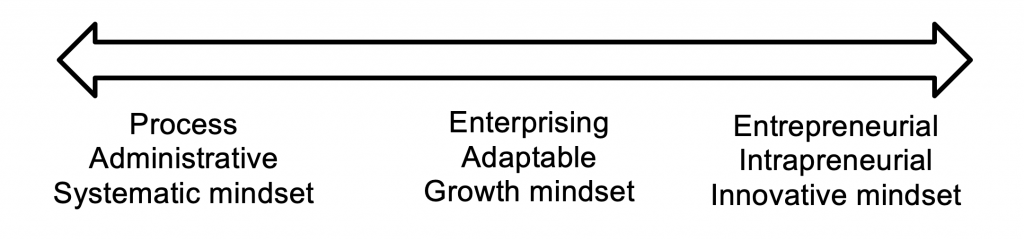
These studies applied approaches to three areas of brain function to identify a spectrum of brain mindsets ranging from strong ‘process’ mindsets to innovative and ‘entrepreneurial’ mindsets. The psychometric developed from this research corresponds to a ‘spectrum’ of behaviours which are all of equal value, but have distinctive contribution to make to a team dynamic.
The spectrum can be represented as a continuum as follows:
The three areas of the brain were:
Amygdala and brain stem
Determines the threshold for behaviour being determined by threat or fear. What is a motivating challenge for some people may be a crippling threat to others. At the Entrepreneurial end of the spectrum, what many would consider a threat is seen as a challenge to be overcome. At the Process end, the threat impedes activity.
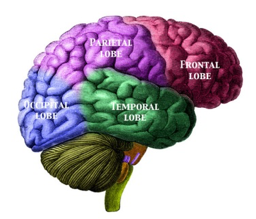
- The amygdala and brainstem
- The pre-frontal cortex
- The left and right cerebral hemispheres
Pre-frontal Cortex
Associated with rewards and motivation and ‘appropriate’ behaviour.At the Process end of the spectrum individuals brains are wired to stay within the boundaries of what is ‘tried and trusted’ and are therefore ‘risk averse’. The Entrepreneurial brain is less inclined to stay within the boundaries of what is considered ‘appropriate’ motivated by challenging such boundaries and therefore more motivated by risk.
Cerebral hemispheres
The difference between these hemispheres in the brain has been sometime been over-emphasised to the point where they have been minimised or even dismissed. However, the broad attention (Gestalt) features of the right hemisphere and the focused attention of the left hemisphere are well documented as is the ‘dominance’ of one hemisphere over another in learning and behaviour. The dominance of the left hemisphere at the Process end of the spectrum contrast with the dominance of the right hemisphere at the Entrepreneurial end of the spectrum.